ESSAYS
October 30th, 2022
R.I.P. Killing Eve
Okay, before you say anything -- I wasn't going to do it. I was going to stay quiet in my little cave, watch this thing I love wrap up in peace, and keep my assassin thoughts to myself.
But, then, you know. And people are maaad.
Listen, I get it. One of the most exciting new shows in recent memory coming to a close, whip-smart and biting and funny in that way take-no-shit women can be so cathartically funny- we expected different. We expected, frankly, better, and I don't begrudge any feral KE stans a bit of frantic panic in the whiplash. Four seasons, and this is how we leave it? This is not my beautiful house! This is not my beautiful murder-wife!
So while I don’t feel the need to, uh, blatantly cyberbully the showrunners, lord knows I’m not immune from a fugue state of finale-induced analysis, carving the thing up to remember why I loved it in the first place and lost it by the end. It worked so well, once! It sparked, it had teeth, it looked absolutely devastating! Remember then?
Cheers, internet. I don't know if this is a eulogy or an autopsy, but who cares. Here's to where we’ve been, where we went wrong, and finally dissecting this whole psychopath thing.
(Spoilers ahead for all seasons, including that finale, natch.)
Part One: I Think About You All the Time

If you're not already acquainted with my one-time addiction for the BBC America/AMC joint production Killing Eve, then I have to assume we've never spoken. Broad strokes for the uninitiated: a tongue-in-cheek spy thriller based on the novellas by Luke Jennings. Russian assassin Villanelle (BAFTA- and Emmy-winning Jodie Comer!) kills people for a shadowy international cabal called the Twelve. Newly-tapped MI6 operative Eve Polastri (Emmy-, Critics' Choice-, Golden Globe-, SAG Award-winning Sandra Oh!) is tasked with tracking her down. Also, they're obsessed with each other. Roll credits.
It's a dark, absurd, funny, women-led, globe-trotting murder romp with style-for-days production design and a killer cast. With all the seductive satisfaction of the spy genre -- cat-and-mouse chase, slick assassinations, smoky soundtrack -- but run through a feminist lens that centers the internal desires of our main ladies above all else. Murder as statement of agency, empathy, and brutality. Fashion as statement of power or lack thereof (or even, sometimes, plot). Jokes that wink, sting, goof, get solidarity snorts from the women in the room. It delivers on theme and it delivers on catharsis and, thanks to a first season written, showrun, and produced by Fleabag creator Phoebe Waller-Bridge, it's established itself as an award-winning tonal outlier within the larger genre.
It's also committed to providing showrunning opportunities for women writers in the form of baton-passing those duties from season to season: from Waller-Bridge, to Emerald Fennell (actress in Call the Midwife and The Crown, Oscar-winning writer-director of Promising Young Woman) in season two, to Suzanne Heathcote (Fear the Walking Dead, See) in season three, and finally to Laura Neal (Sex Education, underrated gem & baby-Jodie-featuring My Mad Fat Diary, Killing Eve season three) for the final shout.
Understandably, this regular changing-of-the-guard alters the tone of the show each time. Less a planned evolution than an inevitable mutation of that original season one DNA, the show warps with each iteration: sometimes like a funhouse (season two's escape from Julian, chef’s kiss), sometimes more like bad Botox in a familiar face (oh, Geraldine). But regardless of its distance from Waller-Bridge’s foundational comedic bite, the show's conceit is such that we always return to the psychology of the two women at its center: the bored civil service worker who might want to be more like the killers she studies, and the "psychopath" assassin who may just want to be loved.
(Yeah, I put it in quotations. Fight me, Martin.)

More than the show’s tone -- though dependent on it to truly succeed -- the iconic murder-duo at the heart of Killing Eve is also its chief bit of brilliance.
Ladies, aren't you bored? Don't you wonder, sometimes, what it'd be like if you stopped censoring yourself, if you weren't holding back? (Aren't you tired of being nice? Don't you want to go ape shit?)
The eponymous Eve is our everywoman, the audience stand-in with an ostensibly normal life. On the one hand that means a weird, boring job and a rumpled work-casual wardrobe; but Eve is a human being, and so it also means a quiet, unspoken urge to transgress. She’s fascinated by female assassins. What makes a woman commit murder, how she manages it -- and how Eve might manage something so seductively destructive, too. Eve’s dark little impulses aren’t quite harmless enough for polite society, and so for the most part they’ve stayed just that: little and dark. Look at this true crime fan test how you could bleed someone out through a tiny incision in the thigh! Look at her telling her husband precisely how she'd kill him, and it's a smart plan, too! (Oh, Niko.) She pushes the boundaries but she doesn’t break them, not totally -- she'd never act on it, obviously. We'd never act on it, obviously. Who would?
Counterpoint: a hyper-competent, chic-as-shit female assassin. Brutal. Mercurial. Funny. Professionally underestimated even as she kills people for a living ("twenty quid it was a woman") and getting away with it right under your nose. Villanelle is violent, hilarious, juvenile, volatile, unrestricted by something as gauche as society’s sense of morality-- and god, is she having a great time. Normal is boring. Villanelle is neither. When Eve’s assassin insight and Villanelle’s actual assassinations cause them to collide, the game is on.
To paraphrase Waller-Bridge: get these two women in a room. That's your show. A professional excuse for Eve to embrace her subversive side? Someone to engage with Villanelle's humanity alongside the violence? What isn't intoxicating about wish-fulfillment? How could you not obsess?

Things are certainly improving, but these kinds of messy female characters are still few enough to feel rare and exciting when we do get them. How often do we get to see weird, complex women being weird and complex on our screens? Weird and complex and funny, unapologetic, calculating and controlling, brutal and furious and lusting and absurd, heartbroken and immature and violent. This is distinct from the relatively recent popularity of, let's call her, the Lady Badass, the token woman who seems to pop up in every mainstream action flick to kick someone's ass, present masculinity better than the men, and call it feminism. (She's a woman but she's strong, you see!) No, we've seen plenty of violence, we've seen mess. Don't show me a woman committing an act of violence; show me what it's like to be a violent woman. To want to be.
Eve and Villanelle are not interesting characters because they commit subversive acts; they commit subversive acts because they're interesting characters. Not conflict for conflict's sake, but driven by desire -- deep-seated and self-contradicting, as real desire so often is. Neither has ever really possessed what they want and it's that pursuit, that exploration, the fear of and desperation for those taboo feelings that's fascinating to watch.
And I mean, what's not galvanizing about seeing such a familiar, male-dominated genre in a shamelessly feminine context? Shuffle the elements of KE -- evil organizations, espionage, international shenanigans -- and you get Bond and Goldfinger, Batman and the Joker. To be reductive: dudes at odds trying to kill each other. But Eve and Villanelle play a much more internal and subsequently intimate game, one both driven and fundamentally defined by its subversion of the usual tropes. You get new weapons of choice: impromptu dinner dates. Clothes that suit you better than anything you could pick out for yourself. Even the chess moves familiar to the genre, uberviolence and killshots, are more charged for being committed by women -- and, often, are driven by a kind of warped empathy, as emotionally complex as they are brutal.
Destruction is not the goal. They're not in it to defeat each other. They're two neurotic messes in high stress work environments trying to understand themselves and be understood in turn-- who are, basically, working through some personal shit. And eventually they realize there's no way one can do it without the other.
That’s the crux of it. It's seeing these chaotic weirdos figure out what they want; realize, in some way, it's what the other has; seeing them collide in peak genre fashion; and seeing them recognize themselves in each other. That they're mutually fixated only intensifies the dynamic for both of them, reinforces the idea that this person is special, actually, that they’re right. Assassin gives spy an excuse to give in to her own fantasies of violent self-empowerment. Spy reminds assassin what it feels like to be, out of love or fury, cared about. A mutual acknowledgment of something destructive and human -- a call and response of I shouldn't want this but I do, and of course you do; why wouldn't you?
It's only natural, really, that that mutual obsession would escalate into twisted romance. (Hannibal certainly understands.) How else would you react to the thing you most want, wanting you back? That wanting it is okay? What else do you do, when you're finally understood?

Oh and Comer's performances, and their characters' dynamic, have anchored the series since the first season -- and that hasn't changed, not with the unfortunate third and not with this roller coaster of a fourth. God, the performances. Seasonal drift be damned, the acting in the show is consistently stellar, which means good writing takes advantage of performers who elevate everything they touch: gripping seasons one and two, and moments of beauty amid otherwise lackluster plotting in three and four. (Villanelle in the garden. “Are You From Pinner?” Eve's talks with Martin, bless the writers for keeping a psychological professional on-hand. Every scene that takes place in a kitchen.)
And none of this is to forget Fiona Shaw and Kim Bodnia. Carolyn Martens and Konstantin Vasilyev, respectively, who have been victims of the second-half tonal shifts as much as their costars. Even more, maybe, given how inextricably tied the MI6 agent and Twelve handler are to the plot, as much as KE has really cared about that. Carolyn and Konstantin have their own sly genre twists to support, but again, it’s all about character. Carolyn's deadpan, brutal pragmatism, making for both excellent spycraft and one-liners. Konstantin's jolly nihilism, a stew of desperate self-preservation and warmth that made enemies of... well, most of the people he knew, yet didn't everyone still love him at the end? Without Carolyn and Konstantin, the plot stagnates. The protagonists forget the game they’re playing is an exploitative one. Without Shaw and Bodnia, we don't keep loving the manipulative little heartbreakers in spite of it.
(Carolyn's grief sandwiches in the car. Konstantin downing pills under duress. The hugs. You get it.)
The characters make this story. The actors make this series. So... where does it fall apart?
Part Two: Jokes Are For People Who Do Their Jobs Correctly

Like points on Whose Line and moral imperatives to an existentialist, the plot of Killing Eve doesn't much matter. Sometimes this is fine: one of the benefits of bold genre is slick, compelling style that can generate strong choices even when your story doesn’t. And one of the narrative benefits of a shadowy cabal is that you can show people its tendrils without always needing to show the actual monster they're attached to. We know Villanelle kills for the Twelve, we know Eve and Carolyn are after them, we know so little about them that it's easy to believe their involvement when it comes up. It's E+V we're invested in; the show functions best when it's most invested in them, too.
But Unloved can only carry mood so far, and your spy thriller's evil puppet masters can't stay in the shadows forever. Eventually we have to start answering the questions you've been posing from the start of the series, which means plot has to matter. And unfortunately, plot is hard.
The writers have always had a difficult balancing act to maintain. The show runs on Eve and Villanelle's dynamic, and that dynamic runs, R.I.P. Villaneve fans, on unfulfilled desire. Every time some of that desire is acquired or another piece of it is understood (catharsis!), we move their arc forward -- but the chase also has to change. They've gotten a taste of their goal and it's altered them, they're not after the same thing as before and so the old way won't work. Thus the nature of the show necessitates constant pivots in the ways its protagonists interact,
while staying true to the rules of their original dynamic,
but making sure to honor how their characters have evolved each time,
and still making sure we're moving towards some kind of satisfying overall resolution of desire,
all without losing narrative momentum.
Oh, and you should probably explore some kind of overarching psychological theme across storylines. And bring secondary characters along on a parallel transformation, too. Oh, and the Twelve!

This kills in season one. The dynamic's new. It's frenetic and it’s flexible. We're still adjusting to irreverence and murder as norm, we're learning the vocabulary of a show where a professional assassin breaks into a secret agent's home just to have dinner with her. (Okay? Okay.) Each new chess move, as surprising to us as to the characters, breaks and recalibrates expectation.
Eve attempts to connect with Villanelle instead of running from her. Pivot.
Villanelle kills Bill for his closeness with Eve. Pivot.
I need help -- bullshit -- shepherd's pie. Pivot.
By the time Eve stabs Villanelle at end of the season (pivot!), we've been taught the rules of the story, which really do amount to: these women are driven by an uncanny mutual understanding.
That’s it. Of course, it’s the subtext and the nuances of that connection that give the show depth, the cat-and-mouse stakes that make it playful and bloody, but the core is quite simple. For now the Twelve is set dressing. MI6 is a vehicle, plot exists to serve that main conceit: your protagonists will inevitably compound potential energy until something explodes.

Season two recognizes this formula and, bless them, runs with it. We kick off with a new showrunner (hello, Emerald!) and a new baseline for E+V. The finale stab is a major statement: we're not questioning Eve having a dark side anymore because she's proven herself capable of, and willing to perpetrate, violence. Eve is like Villanelle, and now we all know it. Your move, V.
If season one was about obsession and revenge, season two gave us shades of addiction and rejection -- now that they’ve discovered this subversive connection, they need to figure out what they want to do about it. But still neither season concerned itself over-much with the actual dealings of the Twelve, nor suffered much for it. Fennell and company took to heart that the narrative energy of KE relies on its characters keeping each other guessing. As a result, they continued the practice of keeping E+V physically separate for most of the season, but they also respected how much of that conflict is internal.
Outside Villanelle's orbit, Eve reacts to her brief indulgence in darkness like a normal human being: she panics and regrets. And Villanelle, now confident that Eve does indeed understand her, pursues her further: though not to reciprocate that understanding, not yet. Distance lets our characters try, and fail, to change the nature of their relationship. By the time they come back together in episode 5, they've only reinforced it further.
Meanwhile, we shelve any true investigation of the Twelve in favor of, essentially, a self-contained proxy plot. The backbone of the season's storyline falls to tech psycho-bro Aaron Peel, along with a really fascinating series of narrative ideas specific to, shall we say, Different Kinds of Dangerous Men: Aaron, the megalomaniac. Julian, the white knight. Raymond, the sadist. Even the cheating husband in Amsterdam. It doesn’t really matter that it’s all so separate from an unraveling-the-Twelve storyline because E+V are still moving and the season still has a point of view. It knows what it wants to say, and Peel helps it say it.
And so the pivots continue. Eve and Villanelle understand each other at least enough to work together. Cue new power dynamics and manipulation, selflessness and jealousy that make fully explicit the romantic text in season one while mostly keeping up the brutal absurdity. (Gabriel’s death might be my favorite in the series. Killer work, Emerald.) Carolyn and Konstantin do their own fair share of puppeteering until we're once again left with a new violent statement in an excellent finale: Eve kills Raymond. Villanelle says I love you and I own you in the same breath. Eve rejects her. Villanelle shoots Eve.
One would think season three has plenty to work with! And yet!

After Rome, KE stops being a powder keg. Season three is the same recipe on paper prepared by different cooks, the same ingredients without an understanding of why we put them together. We get kills. We get Carolyn one-liners. We get, for the most part, Unloved songs. And E+V are once again kept separate -- but we fail to use that distance to generate friction. It’s not rubber band tension promising collision so much as, uh, two separate rubber bands. It’s off.
That time not spent ratcheting up E+V tension is then less successfully put into things more obviously labeled Plot. We care about the Twelve now, sort of. We meet new people with new knowledge of the ur-conspiracy that has the ladies trapped: Dasha, Hélène, Brad, the accountant with the dancing son. Stakes are supposedly raised by killing Kenny (roll credits) and maiming Niko. We’re actually posed a lot of intriguing questions about things so far unexplored -- how does Carolyn react to such a personal emotion as grief? How has Konstantin survived in this line of work for this long? How do the Twelve actually operate?
It’s just a shame that we get so few answers. Aside from a brilliant performance from a car-bound Fiona Shaw, Kenny’s death muddies the momentum rather than drives it. (Did we need a more urgent reason to hate the Twelve? Don’t we already want them gone?) The Bitter Pill crew introduces a new avenue by which to gain intel on the Twelve, but their most helpful contribution turns out to be a conveniently-placed security camera that renders the entire Kenny investigation moot. Maybe the best bit of info in the season comes when Carolyn learns someone at MI6 is collaborating with the Twelve -- but Phoebe sort of told us that already, didn’t she?
I think if you went high enough, you’d probably find we work for the same people.

And then, Villaneve-side, there’s the kiss. The fandom's white whale, the Big Smooch, if you will. Eve and Villanelle send the internet into a frenzy when a bus brawl ends with locking lips and butting heads.
And then they split up! Again! Until the last seconds of the penultimate episode! Suzanne, please!
In another season, it might actually matter that Eve has just admitted to both of them that she can, and will, reciprocate at least some of Villanelle's feelings, just like she proved capable of violence in season one. But here they've been placed on separate and discrete tracks: Eve, on the plodding investigation into Kenny's death; and Villanelle, on becoming a Keeper or learning about her family or one-upping Dasha or fleeing the country with Konstantin or, listen, there were a few things going on.
Why do we need the Bitter Pill, if they won’t tell us anything of substance about the Twelve? Why do we need a kiss (or Villanelle’s whole-ass wife, entirely forgotten after the first episode), if there’s no payoff? Why on earth do we need Geraldine? (I’m genuinely sorry, Gemma Whelan.)
Season three doesn’t know what it wants to say. It certainly doesn’t adhere to KE's primary edict of mutual obsession, and it’s a wholesale departure from tone. Compared to the confrontation in Rome, the season finale -- historically the most intimate and violent -- is sickly sweet and totally fangless. A season of distance has diluted what should be a caustic reunion, and E+V are left to wax over-vague and poetic about their natures without anything new to pay off. As an admission of mutual acceptance, it feels unearned. As a collision between two unstoppable forces, it feels impotent. We did nothing to get here-- we just arrived with an overearnest soundtrack and hit play. (I mean, for god’s sake, throw an Unloved song under that shit, at least.)
The bus kiss feels truer. The bridge scene, I think, would not work were it not buoyed by fan desperation for a resolution.
So Eve and Villanelle walk away. No one knows what’s going on with the Twelve, writers included. We sit in sustained continental drift away from that dark, subversive wink that made the show in the first place, and we get some indication of where we might find ourselves in the end.
Part Three: Sorry Baby

Good television is a blessing. We invest in it for a reason. We obsess over it for a reason. When we find the right story for us, we feel seen, and when it leaves us, it leaves something behind.
And why shouldn’t it? We’re storytelling creatures with dumb imaginations. We conjure emotional responses to fictional people and places and things and when something happens in our heads, we feel it in our bodies. People create these stories for us. We repay them by taking them to heart. We’re connected.
KE fans are, oh, let’s say, "invested," and so it’s no surprise how many of us were lamenting the end before season four even aired. With each episode -- and better ones, too, a bit of our swagger back and thank god Eve learned some self-defense -- the audience mourned a ticking clock. Only eight episodes left! Only six more! Time pressurizes; tone trends serious. Everybody knows we’re building towards something final.
As such, our last season dances the line between familiar pattern and self-aware bucket list: a quasi-competent Eve finally living out some of the spy skills she coveted pre-series. Villanelle and Carolyn bonding time. An honest-to-god attempt to explain the Twelve’s origins delivered via black-and-white flashback (the most serious of dual-color combinations and temporal scene types). A personal hall-of-fame Carolyn moment, tree tree tree. And we get, least surprisingly and most annoyingly, yet another season of majority antagonistic E+V.
Five episodes to go! Three left! Why are the writers so afraid to let these women interact? How are they going to pay it all off?
As a response to season three’s best attempts at muddying the waters, season four is, well, fine. An admirable attempt to make the best of the show’s game of tonal telephone and a mixed bag otherwise. I didn’t enjoy the continued rule of an E+V Separatist regime -- but at least Eve’s arc with Hélène was a strong choice with legitimate, character-defining consequences, something the previous season desperately lacked. I didn’t understand the need for Pam -- but gosh darn it, if she wasn’t just straight-up likable. And most importantly, it did feel like we were getting a legitimate attempt to set the stage for some kind of emotional resolution between Eve and Villanelle -- at least at first. Leads on the Twelve have actual leaders of the Twelve at the end of them. E+V are spiky once more, they’re in the “last ditch effort” stage of rejecting each other, and we know it won’t work.
In a parallel universe, we’d render the Twelve transparent and therefore inevitable, explosive endgame. Eve and Villanelle would finally accept being on the same page and wreak havoc.
In our universe, we creep through without catharsis, episode by episode, until we’re almost out.
We have one episode left.
We get 40 minutes.
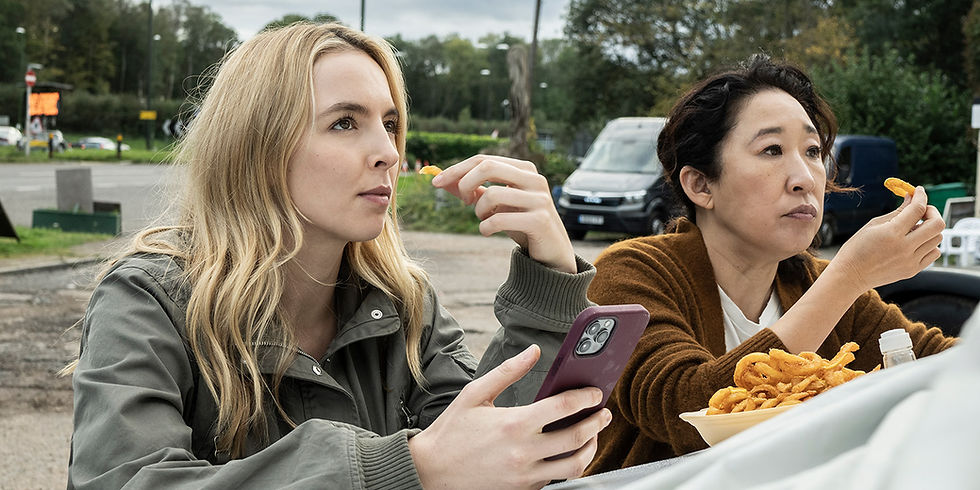
In the series finale of Killing Eve, this is what happens.
Eve reunites with Villanelle. She makes a strangely vague, half-confession of need, the girls go domestic for a pretty cute road trip. Scars are touched. Curly fries are shared. A four-season-long for-the-love-of-god-will-they gets consummated via post-roadside-bathroom-break make out sesh. (Also, for the record, very cute.) Villanelle says weirdly little throughout the whole episode, contributing to the feeling of being flung very quickly through a writer’s room beat board. Goodbye, Konstantin. Good for you, Pam. The Macguffin Twelve meeting gets moved to a boat which Villaneve infiltrate without issue. Villanelle murders the faceless head honchos of the Twelve virtually off-screen while Eve does the electric slide.
And then Villanelle dies. Abruptly and awkwardly. Seconds after liberating herself and Eve from the cabal that’s caused them so much anguish, happiness in reach so time’s just about up. She’s shot once on the boat and several times in the water after the two jump overboard and she, I guess, shields Eve from snipers executing kill orders from Carolyn. There's some heavy-handed religious imagery. The writers -- sorry, "the current of the Thames" drags them away from each other. Eve surfaces. She screams. The End.
Roll credits.
Part Four: You're Mine

First things first. That the subversive tongue-in-cheek spy show with one of the best characters in television, one the best queer characters in television, with a spectacularly gay final season, and (I say with love) one of the most aggressively thirsty sapphic fanbases I've ever seen, ends up succumbing uselessly to the Bury Your Gays trope is at the absolute least, uh, a big fuckin' bummer. That it concludes with Carolyn not just as a kind of villain, but a startlingly callous one for how much unexpected warmth she's delivered throughout the series, is a bit of heartbreak in and of itself. But that it seems to have misconstrued the heart of the show to such an extent is a hell of a bittersweet taste to be left with in the end, especially given how deliciously we started.
I'm less mad than disoriented. (EDIT: 2025 Charlotte here, I'm definitely just mad now.) There used to be an incredible show in here somewhere! There were rules to this story and they have been broken. It doesn't feel like a sad twist. It feels incorrect.
Let me be clear: Sandra Oh and Jodie Comer can act the shit out of anything. But this episode felt foreign, its rapid reconciliation between our girls yet again unearned (which is saying something, given how long we've been waiting for it). We've been hearing from the jump that these characters can't coexist, that they will destroy or consume each other or explode -- and here Eve is rolling up to an island and slipping into sudden easy coexistence? What happened to the potential energy? It may be long-overdue wish fulfillment to see them united. But four seasons of complex subverted desire cannot be resolved in thirty seconds with a vague I need you confession that leaves the majority of their baggage unaddressed. The whole point is that these women are birds of the same fucked-up feather, have endured -- and inflicted on each other -- legitimate trauma, and still choose, inevitably, to come back together.
In other words: don't tell me the bitches whose best bonding moments involve switchblades and cyanide make up after thirty seconds of dialog and a hike? And definitely don’t tell me that none of it will matter in the end?
Frankly, if I learned anything from “Hello, Losers” it's that, as compelling as Sandra and Jodie are when they're at odds, they're just as compelling when they're on the same side. Maybe more, given we've seen four seasons of conflict and only about 40 minutes of contrived, if long-awaited, unity. I'm all for acknowledging the ratio of the show has skewed more love story than thriller, so commit to both! It tinges my disappointment with a bit of "look what we could've had" -- Eve and Villanelle in lockstep, for however long they could manage it, turning their combined chaos on the powers that be until they finally turn on each other. If we can agree that this is the messy truth of their characters, if they're so doomed to self-destruct -- if they're so fun to watch at their most destructive -- then show us. And give it more than one episode.

Of course, there is no real correct and incorrect here. There is subjective thought from every showrunner and television executive and r/KillingEve conspiracy theorist, and so all I have is what I believe about the show. And as it turns out, I think I just disagree with Laura Neal.
In post-finale interviews, Neal has described killing Villanelle (roll credits) as a way to "allow Eve to finally move on from the obsessive, problematic relationship between the pair," in order to "give Eve new life," some kind of "rebirth."
But isn't that... the opposite of the point?
Over four seasons, Eve has (in Oh's own words) gone from being awakened to this dark side of herself, to fearing it, to avoiding it, to finally meeting it. She shoots a guy in the head because she wants to. She finally rejects the prospect of the “normal” life she led at series start in favor of rowing a boat to Secondary Character Island to be with Villanelle. What is the use of severing this connection minutes after it's fully realized? Why did Eve commit to such a protracted, painful journey to embrace this part of herself if we’re going to punish her for it? Where is Eve supposed to go from here?
Girl, she's all in. She's already been reborn.
And what about Villanelle? She's grown to realize that loving someone is not the same as owning them, that whether her behavior is nature or nurture it is all unequivocally hers. She's changed, too-- even within the confines of this season, she already tried to sacrifice her life by cloistering herself in the name of societal morality. Just because it didn't stick, doesn't mean it doesn't count. What makes this attempt different? That Eve isn't being a dick to Villanelle anymore, that they survived the first try? Villanelle stops trying to suppress who she is, finds her own humanity in the process, and dies for it. I don’t care who you are or what the show is -- that’s absolutely bleak.
I believe Killing Eve ends with a refutation of its own premise. I think it ends with a rejection of the thing that made it special, and personal, and strange, in favor of something rushed, and contrived, and meaninglessly brutal. Those dark little impulses that feel so quiet and true, that said I see you, weirdos -- that make me, weirdo, feel seen: they’re unsustainable. They’re too destructive. They’ll get someone killed.
During the tea dance in season three, E+V see a carefree older couple on the dance floor. Villanelle asks Eve if she wants to be like that.
"Not anymore. [...] We'd never make it that long," Eve says. "We'd consume each other before we got old."
In true season three fashion, Villanelle stays sincere. "That sounds kind of nice."
I'll always love Killing Eve. It’s the kind of story that makes you thankful it exists. (Everything Everywhere All at Once, Flowers, Russian Doll, get to know me very quickly.) It’s the kind that speaks a language I understand, the self-contradicting totality of desire, panic, darkness, rage, humor, heartache, existing as a woman in a world so often dedicated to making that difficult. We need more women telling more stories that can convey us. More empathetic portrayals to show us all the strange angles of ourselves in unexpected ways. We need people like Phoebe Waller-Bridge and Emerald Fennell and Sandra Oh and Jodie Comer and Fiona Shaw because they help us understand ourselves.
They gave us something honest. We’re connected.
So in the end I’m choosing to remember the show split in two: the Killing Eve of the first two seasons, and the hazy, Scooby Doo possibility of the latter. Here's how it really happened, and here's one way it could've gone from there. A group of very hardworking people have shot this second version already. It ends bizarre and abrupt in the Thames.
Personally I think, somewhere else, there are two exceptionally well-dressed not-quite-psychopaths doing something unhinged. They're chic as shit because it makes them feel powerful, and they’re going out in a blaze of glory. They probably don't make it.
Lots of nice folks have ideas on how they get there. I'm not sure how it ends.
That sounds kind of nice.
x
Char's (Personal Favorites) Watchlist:
-
S1E2 "I'll Deal With Him Later," writ. Phoebe Waller-Bridge ("Frankly, I don't give a shit anymore. She is outsmarting the smartest of us, and for that she deserves to do or kill whoever the hell she wants.")
-
S1E3 “Don’t I Know You?” writ. Vicky Jones (“No, dresses like that require women to go bra-less. A monkey could tell you that.”)
-
S1E5 "I Have a Thing About Bathrooms," writ. Waller-Bridge ("Is that a sweater, attached to a shirt? It is two separate pieces? How does it work?")
-
S1E8 “God, I’m Tired,” writ. Waller-Bridge (“What do you want? Honestly. Don't be a dick.”)
-
S2E1 "Do You Know How to Dispose of a Body?" writ. Emerald Fennell ("You're funny." "Yes. I am funny.")
-
S2E2 “Nice and Neat,” writ. Fennell (“This is what you get, Julian.”)
-
S2E7 “Wide Awake,” writ. Fennell (“I want the recipe to your shepherd’s pie.”)
-
S2E8 “You’re Mine,” writ. Fennell (“The shoulder? The shoulder? Eve, the shoulder?!”)
-
S3E5 “Are You From Pinner?” writ. Suzanne Heathcote (“You are not a child.” “I want to feel like one.”)
-
S4E6 “Oh Goodie, I’m the Winner,” writ. Kayleigh Llewellyn (“Mm, yeah. Tree. Tree tree tree.")